case study
AI Boardroom Forecast Audit
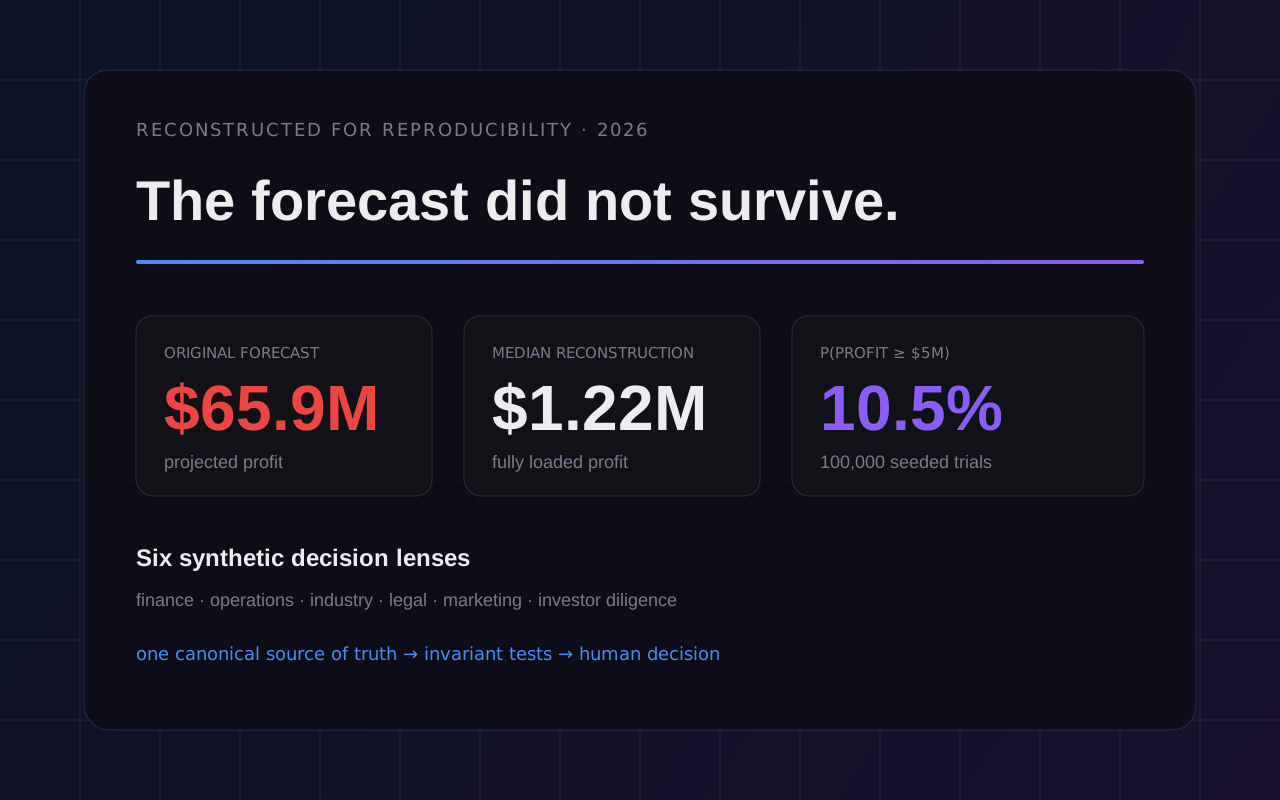
The AI boardroom that killed a $65.9M forecast.
The authority boundary behind all of this work is stated once, in the model cannot own the money. This page covers what is specific to AI Boardroom Forecast Audit.
01 the problem
An AI-built operating plan for a real Houston festival concept produced an approximately $65.9M profit forecast. A six-seat synthetic review cut the headline dramatically, but a later audit found that even the corrected workbook mixed incompatible expense definitions.
02 the solution
Reconstructed the decision as a transparent Python model with 100,000 seeded Monte Carlo trials, standardized regression sensitivity, committed outputs, and invariant tests. Historical claims, reconstructed analysis, and real planning inputs are labeled separately.
03 decisions & tradeoffs
Competing roles over one agreeable assistant
The review needed distinct incentives and downside ownership, not six paraphrases of the same optimistic answer.
One canonical assumptions schema
Consensus did not prevent arithmetic drift. Every view must regenerate from the same definitions.
Reconstruction labeled explicitly
The original run outputs were not fully preserved, so the public model is marked as reconstructed for reproducibility in 2026.
04 tech stack
Synthetic executive review
Finance, operations, industry, legal, marketing, and investor lenses submitted competing objections.
Monte Carlo simulation
Seeded trials stress-test sell-through, revenue execution, expense variance, weather, sponsorship, and delays.
Regression sensitivity
Standardized coefficients expose which uncertain inputs drive the modeled outcome.
Invariant tests
Machine-checkable reconciliation blocks incompatible definitions from quietly surviving consensus.
05 results
- Reconciled a $3.397M gap between reported and fully loaded base-case expenses
- Median reconstructed profit: $1.22M
- Probability of reaching at least $5M: 10.5%
- Deterministic outputs, tests, evidence ledger, and limitations published publicly
Next step
Want something like this?
Book a 30-minute call. I will tell you plainly whether I can help and what I would test first.